



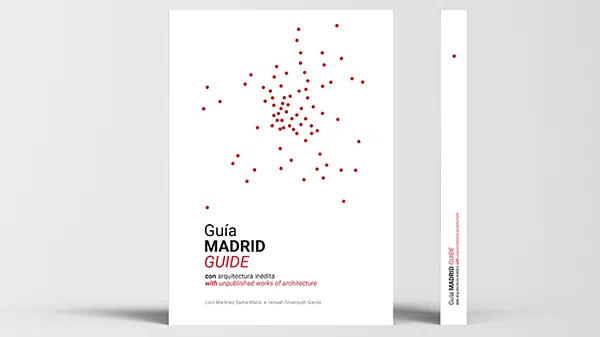
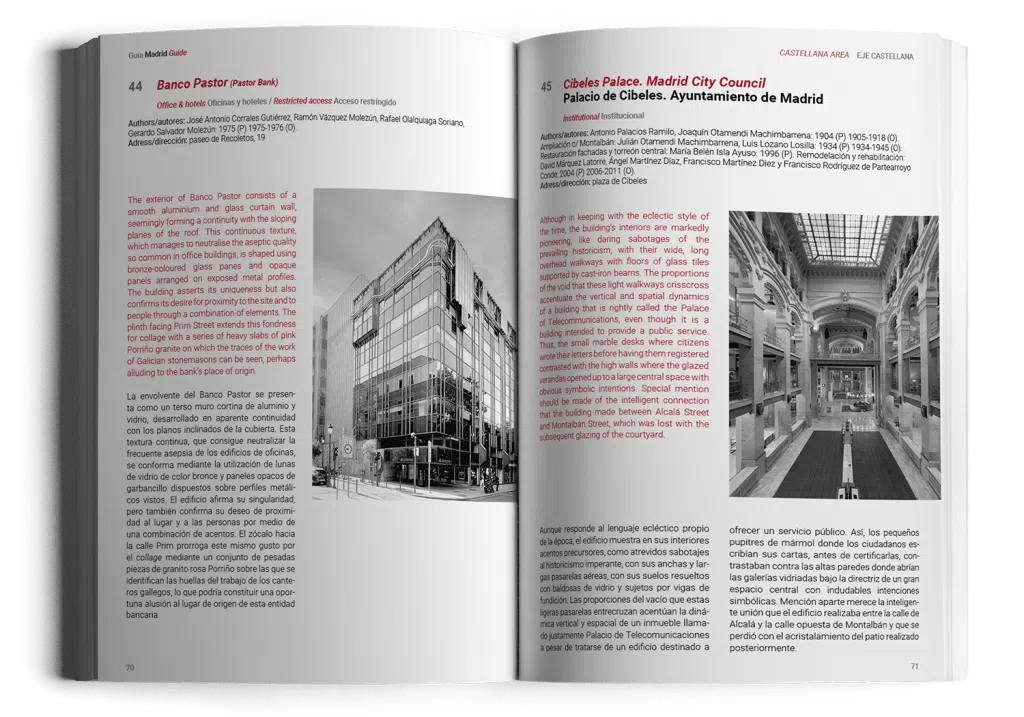
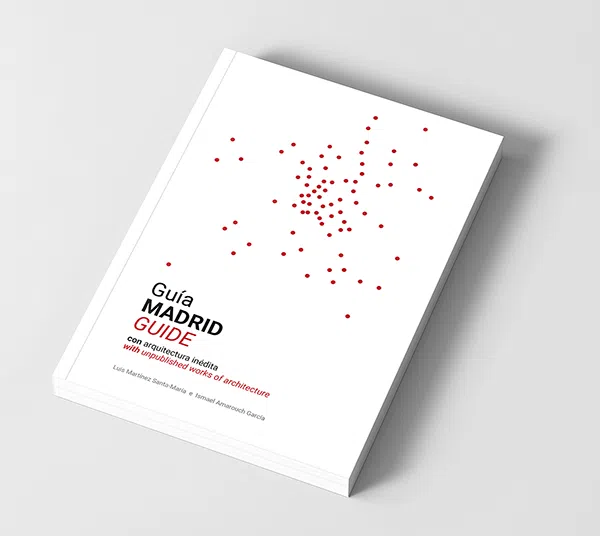
This Madrid guide, with recommendations that an architect would give to an imaginary colleague preparing for a short stay in Madrid and its surroundings, has been condensed into a pocket-sized book, easily manageable and transportable. The guide offers a series of routes allowing one to discover the best episodes of Madrid architecture.
The selection of works does not aim to be extensive but rather focused and organized to enable a comfortable visit to the most outstanding examples (Center, Castellana Axis, University and Cornice, Outskirts, and the Community of Madrid). Also, in Guía Madrid Guide, there is a classification by typology, as within the 156 works of Madrid’s architecture, there are residences, public spaces, offices, hotels, religious buildings, cultural establishments, sports facilities, educational institutions, government buildings, healthcare structures, commercial spaces, and transportation facilities.
The architects acting as guides, and who have succinctly described the teachings of each included work, are Luis Martínez Santa-María (Professor of Projects at ETSAM, Polytechnic University of Madrid) and Ismael Amarouch (Professor at the Faculty of Architecture and Design, Finis Terrae University, Santiago de Chile).
Buy
Visitors to Madrid who are interested in architecture will find here a reasoned description of the 156 works they should definitely explore, and the features that make them excellent examples of the great Spanish masters of the 20th century and of the most anonymous builders.
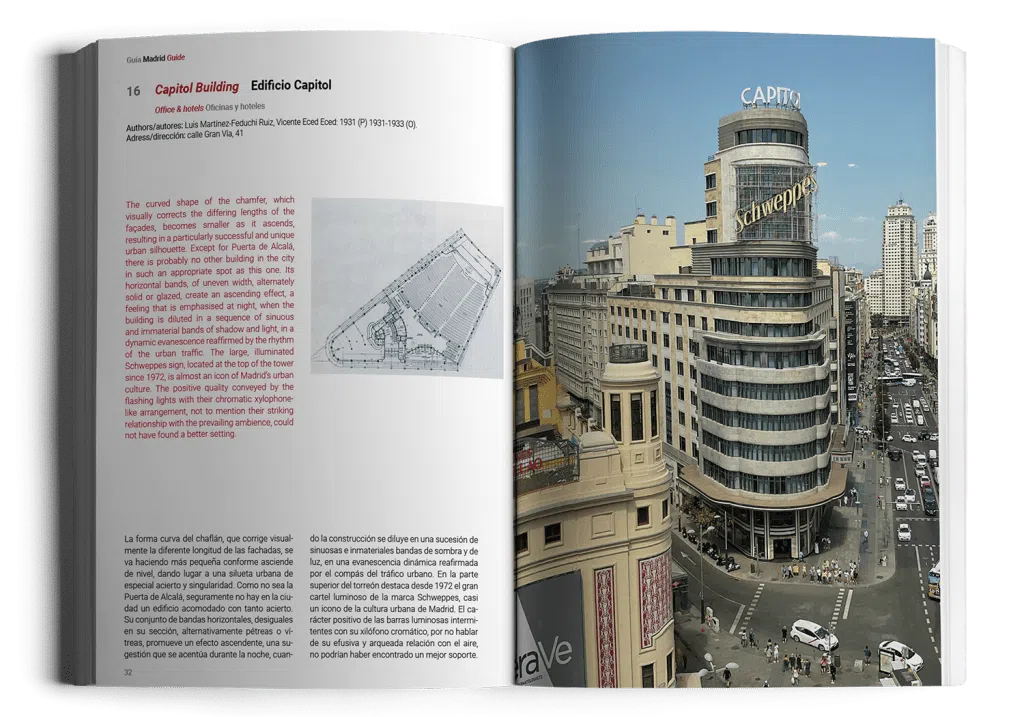
The works of Madrid’s architecture in the Madrid Guide indicate a list of architects, dates, exact addresses, photographs, and a brief text that succinctly describes the particularity of each building. Additionally, it includes a QR code that leads to a map on Google Maps with the works from this architecture guide, allowing you to easily locate and explore them.
Buy
Guía Madrid Guide Index
CENTRAL DISTRICT
Madrid is a large city, but the dimensions of the central districts can be easily covered on foot: from the Crystal Palace in the Buen Retiro Gardens to the Manzanares Heights the distance is about four kilometres.
Madrid’s Moorish origins and the subsequent succession of medieval walls have resulted in a city centre of narrow streets, with loosely concentric layouts based on the dominant position of the Royal Palace and the great urban counterweight of Paseo del Prado and the Buen Retiro Park. Among these, you’ll find these 30 works of Madrid Architecture.
Because of this proximity, all the architectural features in this chapter could be explored in a day. We recommend following the sun, starting from the east and watching it set from Las Vistillas, beside the Segovia Viaduct or from Oeste Park, next to the Temple of Debod.
CASTELLANA AREA
Paseo de la Castellana has been Madrid’s great repository of 19th and 20th-century architecture. From Paseo del Prado (the first European public boulevard, established in the 16th century by Philip II) and its initial extension of vegetable gardens to the north (Paseo de Recoletos), Paseo de la Castellana begins at Colón Square and stretches for 6.5 km to the junction with the M-30 urban motorway, bridging a difference in height of 80 metres.
Along the way, we will find, on both sides, some of the most important buildings of Madrid architecture by the generation of architects who worked between the 1920s and the end of the last century.
A stroll along these seven kilometres is not tiring; in addition to the works highlighted in this Madrid guide, the traveller can enjoy many other valuable architectural specimens that would justify a second volume in their own right. In any case, it is advisable to walk from north to south, starting at Diario Arriba, so that gravity can help complete the walk to Atocha Station.
UNIVERSITY AND CORNISA (MADRID HEIGHTS)
Around 1930, construction began on the University District, an ambitious development plan directed by the architect Modesto López Otero, which aimed to concentrate, in the north of Madrid, the various university faculties and schools that had hitherto been scattered around the city centre.
Some buildings are still there, serving the same purpose and in full operation almost a hundred years later. Other projects (halls of residence, libraries) have been catering for the needs of university life. From the great platform of the University District, we can follow the path, skirting Oeste Park, towards the lower part of the Madrid Heights.
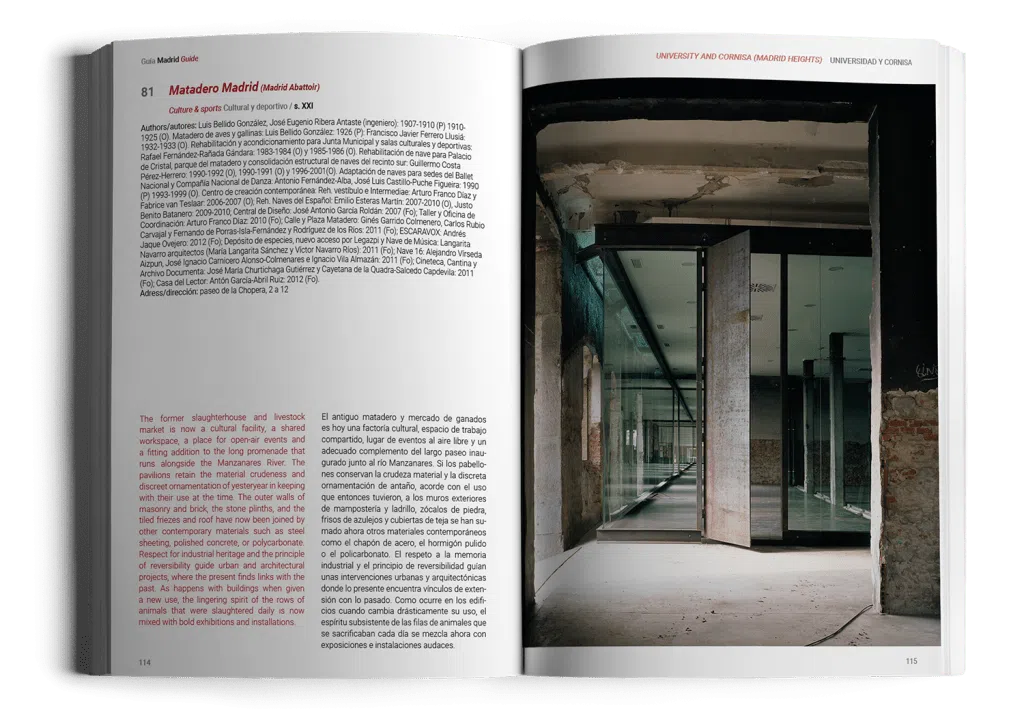
There, with the River Manzanares as a modest centrepiece, we will come to an area, not long ago beset by the urban motorway M-30 (happily buried since 2012), which includes Matadero Madrid (Madrid Abattoir) as the great cultural catalyst of the southern part of the city. So, these 26 architectural works are noteworthy in this Madrid guide.
OTHER
Using the M-30 urban motorway as a boundary, we have identified some works within this area as “Other”. Although part of this motorway is underground (to the west of the city), its ten or twelve traffic lanes transform this river of cars into a ring road that clearly segregates the city.
The Madrid architecture we propose are mainly located in the city’s 19th and 20th-century urban expansion areas (Salamanca, Chamberí, Nuevos Ministerios) or towards the south of the city centre, in Lavapiés.
The works in this and the following chapter (“Periphery”) are so widely dispersed that it is advisable to use public transport, such as the Madrid Metro, as it covers the entire city and there is always a stop nearby.
PERIPHERY
Bearing in mind that the outlying districts of Madrid reach the municipality’s borders, it is easy to understand why this town of modest origins has become a city of more than three million inhabitants.
Since the 1960s, the growth of commuter neighbourhoods, with social housing developments that reached their peak of architectural quality between the 1980s and 1990s, have been gradually taking over the undeveloped municipal territory, with an extensive layout and a series of unique and varied architectural types.
In this section of Guía Madrid Guide, there are 28 architectural works in Madrid, such as single-family houses on the outskirts, paradigmatic of their designers (Corrales-Molezún, Sáenz de Oíza), large social housing developments in Palomeras (De las Casas, Frechilla-López Peláez-Sánchez, Torres-Martínez Lapeña) and cultural infrastructures built by new generations, pupils of the aforementioned architects.
AUTONOMOUS COMMUNITY OF MADRID
Madrid is the capital of Spain and also the capital of the central province of the same name, which, since 1983, has been an autonomous community in the territorial system that shapes the Kingdom of Spain.
This chapter includes the works located outside the municipality of Madrid and, in the same spirit as the rest of the book, we believe they are the ones that any traveller interested in architecture should visit.
Considering the size of the Autonomous Community of Madrid, one must have the time and the appropriate means of transport. Universal buildings such as the Monastery of San Lorenzo del Escorial (a UNESCO World Heritage Site), the thrilling canopy of the municipal swimming pools in Cercedilla or the Culture Centre in Ciempozuelos are equally educational.
Buy
Prologue: THE ANTI-UTOPIA OF THE CITY. By Luis Martínez Santa-María
It is immediately clear that the city is the place of collections. There are collections of columns and windows, of arcades and passageways, of quotations and legends, of proper nouns and common nouns; and there are, above all, collections of errors and successes. Human figures are also part of an incessant waltz, human examples.
Such is the city. It is a collection that stimulates itself, that strives for impossible boundaries, that indulges in the idea that its collections – animate or inanimate – always seem incomplete, and enjoys the contemplation of other collections, better or worse, which it imitates or rejects. And if the city is a collection, the house, which is the city’s city as André Breton desired, is where a unique collection comes together: the collection of life.
Long before nature enters the city through open urban spaces, or through parks and groves, it enters the city through the house. It has done so by painting nature, with static or kinetic images, with embroidery and borders, with domestic animals, with the warped curvatures of the wrought iron of so many locks and gates, or with screensavers. And the city, because some rooms in its many buildings house the microscope and the telescope, because its museums contain art, presents an unprecedented nature, an ultimate nature that has yet to be plundered.
The fact that some urban natural science museums eventually became art museums also speaks for itself. The art housed in many of their halls reveals the world in which we live and in which we should live. A soluble, untouched nature finally reveals this plot of incisive and watchful rooms that is the city. The city, which could so often resemble an unbridled joke of nature, erupts before us as nature’s pride.
A mixture of indifference and passion, of instability and equilibrium, of monotony and diversity, of hope and despair, the city is primarily a confluence. We are witness to the revelation that it is a past dream and a future dream, the work of many. And this being the case, we recognise that the city is also a present-day dream. The time that supposedly belongs to us because we live within its symbolic walls is thus a spiral of times, a deep and intangible, not to say undeserved, accumulation of time.
All this is magnificent, enriching, even enviable. And yet, the city is never wonderful. It will never be a perfect landscape. It will never be the ideal for anyone. Nothing could be further from the dream of the city than the city itself. It is what we all say. But perhaps it is precisely this anti-utopia of the city, this radiant severity of its countenance, similar in part to our own, that makes us love it and never want to leave it.
Buy
Extract of Guía Madrid Guide
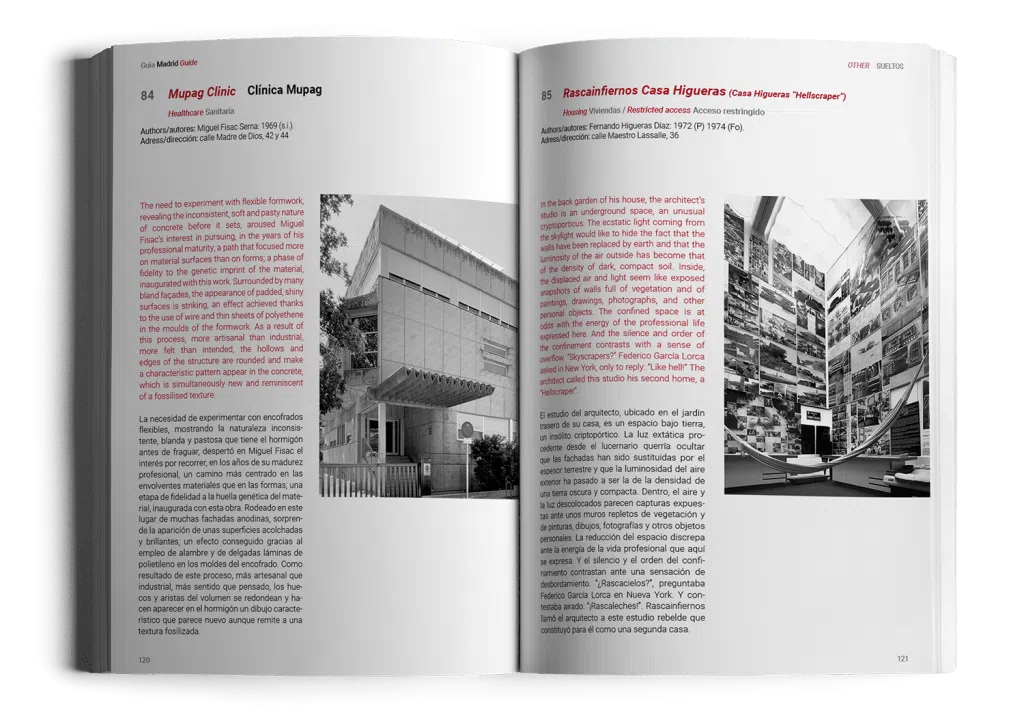
85. Rascainfiernos Casa Higueras (Casa Higueras “Hellscraper”)
Housing Viviendas / Restricted access Acceso restringido. Authors/autores: Fernando Higueras Díaz: 1972 (P) 1974 (Fo). Adress/dirección: calle Maestro Lassalle, 36
In the back garden of his house, the architect’s studio is an underground space, an unusual cryptoporticus. The ecstatic light coming from the skylight would like to hide the fact that the walls have been replaced by earth and that the luminosity of the air outside has become that of the density of dark, compact soil.
Inside, the displaced air and light seem like exposed snapshots of walls full of vegetation and of paintings, drawings, photographs, and other personal objects. The confined space is at odds with the energy of the professional life expressed here. And the silence and order of the confinement contrasts with a sense of overflow.
“Skyscrapers?” Federico García Lorca asked in New York, only to reply: “Like hell!” The architect called this studio his second home, a “Hellscraper”.
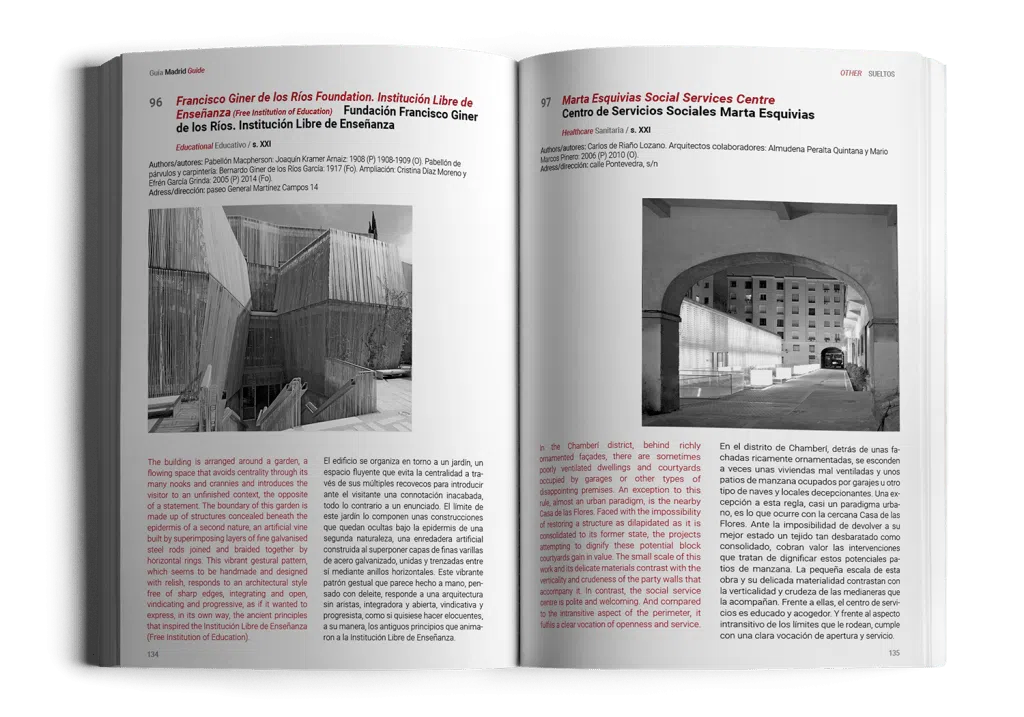
97. Marta Esquivias Social Services Centre. Centro de Servicios Sociales Marta Esquivias
Healthcare Sanitaria / s. XXI / Authors/autores: Carlos de Riaño Lozano. Arquitectos colaboradores: Almudena Peralta Quintana y Mario Marcos Pinero: 2006 (P) 2010 (O). Adress/dirección: calle Pontevedra, s/n
In the Chamberí district, behind richly ornamented façades, there are sometimes poorly ventilated dwellings and courtyards occupied by garages or other types of disappointing premises. An exception to this rule, almost an urban paradigm, is the nearby Casa de las Flores.
Faced with the impossibility of restoring a structure as dilapidated as it is consolidated to its former state, the projects attempting to dignify these potential block courtyards gain in value.
The small scale of this work and its delicate materials contrast with the verticality and crudeness of the party walls that accompany it. In contrast, the social service centre is polite and welcoming. And compared to the intransitive aspect of the perimeter, it fulfils a clear vocation of openness and service.
102. Manuel Losada Shoe shop. Zapatería Manuel Losada
Commerce Comercial / Authors/autores: Paco Alonso: 1986 (P). Sin finalizar. Adress/dirección: calle Jorge Juan, 55
It is not only the value of the materials or the architectural discipline and indiscipline with which they are arranged and coexist. It is not only the boastfulness of the large slabs of green onyx from Iran, the black marble from Calatorao and the red travertine from Almeria supporting each other without mortar.
It is not only that the architecture resembles the art of construction. The ruthless intelligence that springs from living things establishes an original ethic of a superior nature. Somewhere the author speaks of emancipation. Here the subjective meets the objective, the cyclopean meets the detached, the titanic meets the tiny, discipline meets defiance, the abrupt meets the disconcertingly affable. These themes lead us today towards unknown people.
Buy
Guía Madrid Guide authors
Luis Martínez Santa-María is Professor of Architectural Projects at the Higher Technical School of Architecture of Madrid. Among other distinctions, he has received the Madrid City Council Architecture Award (1991), the Manuel Oraá y Arcocha Award (1997), the ASCER Award (2005), the Hispalyt Award (2009), Silver at the Fritz Höger Award (2014), the FAD Award (2017) and the Luis Moreno Mansilla Award (2017). Luis Martínez Santa-María is the author of the following books:
El árbol, el camino, el estanque ante la casa (The Tree, the Path, the Pond before the House) (2004) (Extraordinary Doctoral Thesis Prize at the UPM and published by the ARQUIA Foundation), Intersecciones (Intersections) (2005), El libro de los cuartos (The Book of Rooms) (2011), Principios (2012), Superposiciones (Superpositions) (2018), Contacto (Contact) (2020) and La expresión del peso (2021), also published in English (The Expression of Weight), the latter the result of research conducted during his stay at the Royal Academy of Spain in Rome (2012).
He has been a Member of the Quality Commission of the City of Madrid (2010-2011), Member of the Commission for the Protection of the Historical and Artistic Heritage of the Madrid City Council (2012-2018) and Director of the Arquia Foundation’s book collection La Cimbra (2005-2015).
Ismael Amarouch García (Casablanca, 1983) is an architect (2014), who holds a Master’s Degree in Advanced Architectural Projects (2016) and a PhD in Advanced Architectural Projects (2023) with an outstanding cum laude qualification and international mention, from the Escuela Técnica Superior de Arquitectura (Higher Technical School of Architecture), Universidad Politécnica de Madrid (ETSAM-UPM).
At this university, he was a mentor lecturer and teaching intern in Architectural Projects between 2015 and 2020; collaborator in the “14 Km” book series; co-editor of the book “Vivienda colectiva y clima en España” (Collective Housing and Climate in Spain); fellow of the Collective Housing Research Group (GIVCO, 2018) and research coordinator in the Master’s Degree in Collective Housing (MCH, 2019).
Doctoral research stay at the Royal Institute of Technology in Stockholm (KTH Arkitekturskolan, 2022). Author of articles in specialised publications and presentations at international conferences. In the professional field, he won first prize in the Renove Fuencarral ideas competition (COAM, 2015). He is currently a lecturer at the Advanced Research Laboratory, School of Architecture and Design, Finis Terrae University, Santiago de Chile (FAD-UFT).
Coming soon, we will have a presentation at the Madrid Architects’ Association (COAM) with the authors of this book on Madrid architecture.